The new fp400 is marketed with having appealing features like spatial intelligence that respects your privacy, simultaneous multi-person tracking and real-time headcount.
“Track up to 10 people in real time across multiple zones. FP400 helps smart homes respond more intelligently in shared spaces by recognizing not just presence, but location.”.
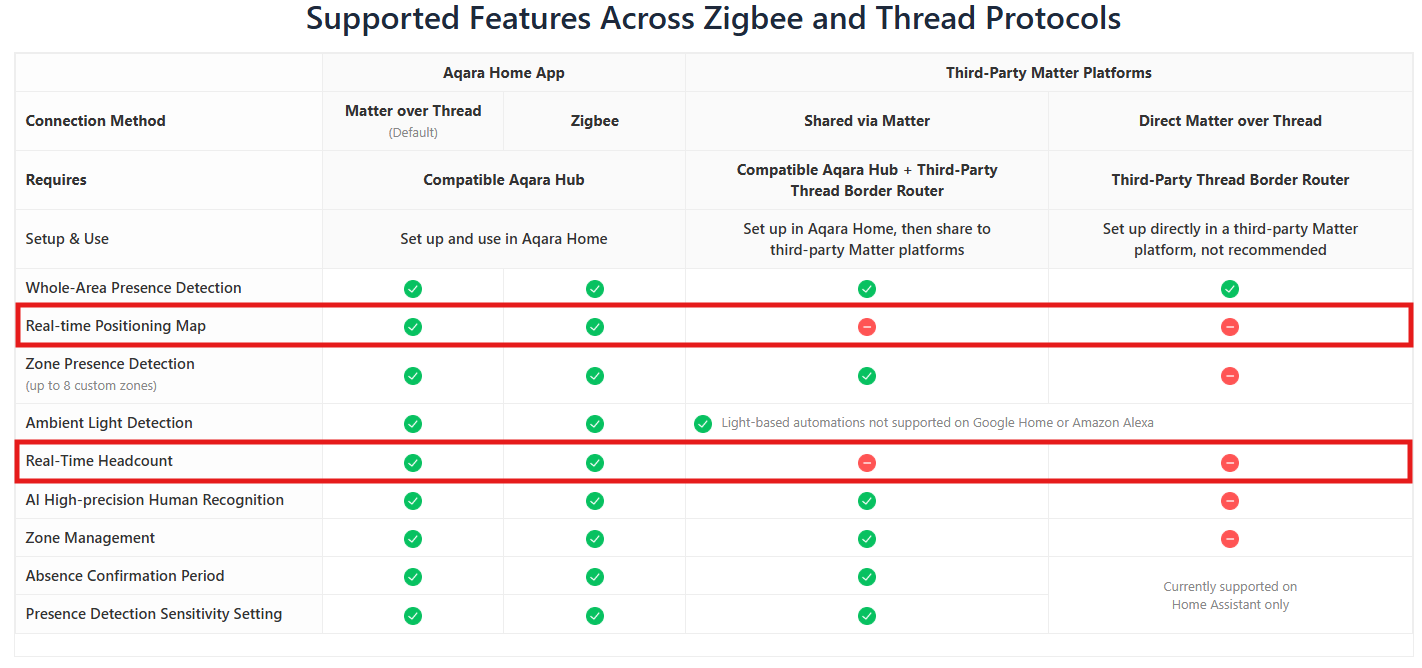
But these features are intentionally locked away from Home Assistant. You can only access them dem within the Aqara app on your phone, provided you also buy one of their hubs.
No matter whether you use Matter, Zigbee, connect through ios Home, or connect directly to a thread router / inside Home Assistant, the only features available to Home Assistant are less - not more - than what’s available in the fp2.
The only entities exposed to HA are the binary Occupancy (true/false), and any of up to 8 zones you’re allowed to create (down from 30 in the fp2).
You don’t get headcount, you don’t get to track individuals or know where they are.
As to whether the fp400 has greater accuracy isn’t the point - the point is that Aqara’s business model is vendor lock-in, not the democratization of IoT and the move away from needing a dozen apps to control your home.
If you want the features they lead in their advertising, you must spend far more than just the price of the fp400, and be willing to move your home automations out of Home Assistant and into a 3rd party closed system. That they claim “respects your privacy”. Caveat Emptor.
Hi there! I think calling it a major backwards move might be a bit of a stretch. The claim that features are intentionally locked away is not quite accurate. There are solid technical reasons for this, mostly tied to the current architectural limitations of the Matter protocol. Matter simply does not support standardized clusters for coordinate based real time tracking or headcounts yet. It is not fair to blame Aqara for that.
As shown in the official product description, third party Matter platforms just do not support the real time positioning map or headcount right now. The fact that Matter is supported contradicts the idea of intentional vendor lock-in.
Also, the device is not officially supported by Zigbee2MQTT yet. As someone who deals with these protocols in Home Assistant a lot, I suspect that once it is fully supported, we will likely be able to extract the raw payloads and get much more granular control locally.
Finally, the improved accuracy is the main reason to buy the FP400. If you prefer the old setup, the FP2 is still available! Let us wait and see what the developer community achieves once the Zigbee integration is fully ready.
There is a community integration that basically provides the full feature set directly in home assistant using matter independent of Aqara hubs and/or Aqara Home. Apparently it’s still in development but for me it already works pretty well.
Check out:
That is really cool! It is great to see that someone put in the effort to utilize the manufacturer specific extension clusters via Matter. Good point, that is of course another option besides Zigbee that I had not even thought about.
Theoretically, other manufacturers could also use the clusters and integrate them into their apps, for example the Apple Home app. The question is, why would Apple do that? It would make more sense to find a common standard for such features, though that might take some time. And that is exactly the core issue: one manufacturer has special features while others do not, yet they are all supposed to agree and establish a standard for it… difficult.
I was looking at Fp400 but given its limitations without the Aqara hub I will probably get Fp300 or some other presence sensor. This is my second go at the smart home and one thing I learned from my first venture is that I do not want a bunch of hubs from different vendors and different apps to install.
The community integration linked above is a different path from the entities exposed by the standard Matter integration, but I would read its requirements before treating it as a drop-in alternative to a hub. The current README says it targets the FP400 in Matter/Thread mode, not Zigbee, and requires a Matter server with the FP400 vendor clusters. It also warns that changing the server’s fabric vendor ID requires commissioning every Matter device on that server again, not just the FP400. That is an important caveat if you already have a working installation.
My own FP400 automations in Home Assistant use presence for lighting, stopping media and API-controlled climate. That is useful to me, but it does not verify the headcount or coordinate features you are looking for. I would make the buying decision around the exact data you need and whether this community route’s requirements are acceptable, rather than assume the custom integration and the normal Matter entities provide the same feature set.
Backward compatibility should be a major consideration whenever new hardware or firmware is introduced. I’d be interested to know which specific features or integrations have regressed with the FP400 and whether there are any practical workarounds.
It’s important to note there, that neither the ZigBee nor the Matter specification has support for the advanced features the FP400 offers currently so Aqara has to rely on custom extensions to support them.