This feature is already included in the Matter specifications:
MatterScheduleConfiguration Feature
This feature indicates that the thermostat is capable of schedules. If this feature is supported, the thermostat SHALL support a mechanism to do time synchronization.
Error: After enabling “Valve Detection Notification,” a malfunction occurs after a while. You don’t receive any notifications, the device displays an exclamation point in a triangle, and app control becomes unavailable. However, Smart Schedules continue to work.
Removing and reconnecting the device in the Aqara Home app resolves this issue.
If you leave the device alone and do not control it through the app, then after about 4-5 days the device becomes offline and it is no longer possible to control it remotely.
It maybe more about the app than the thermostat - but I can’t get device settings page, instead of it I got completely blank page. So I can’t yet remove and add the device again. The device is connected to M100 bub.
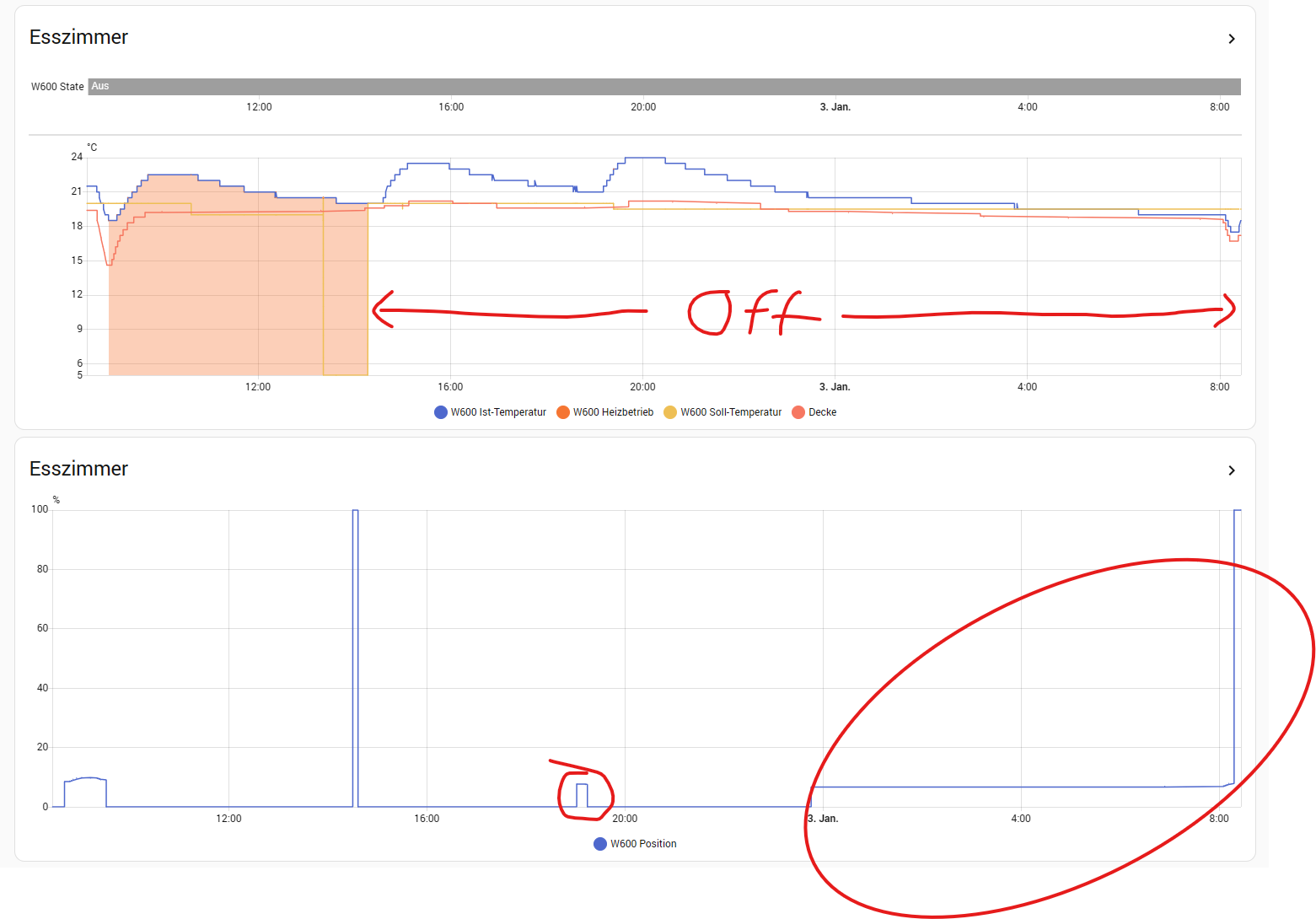
Ich habe seit ein paar Tagen ein W600 zum Testen angeschafft. Wenn das Thermostat “Aus” ist, wird trotzdem automatisch das Ventil unregelmäßig geöffnet, was nicht sein darf. Es regelt automatisch die Temperatur ohne das etwas eingestellt ist. Ich nutze Zigbee über Home Assistant.
Hierbei handelt es sich um ein bekanntes Problem mit der Zigbee-Firmware. Es gibt ein Update, das möglicherweise Abhilfe schafft. Da das aber noch in der Beta-Phase ist, muss man dafür erst vom Support freigeschaltet werden. Ein Support-Ticket kan hier erstellt werden.
Außerdem funktioniert die Aktualisierung der Firmware aktuell nur über die Aqara-App.
Muss euch aber die vorfreude etwas nehmen. Auch mit der neuen Firmeware, laufen die W 600 immer noch nicht sehr gut.
Habe 3 Stück mit W100 verbunden.
Der erste steht abends auf 18°, Tagsüber 20°. Tagsüber heizt er immer auf 22° und abends senkt er auf 20° und heizt wieder auf 21°.
Der zweite abends 18°, Tag 20°- Tagsüber macht das Thermostat bei 19,5° zu und die Zeiteinstellungen werden immer gelöscht.
Ich erstell gerade einen Sammelthread für die offenen Punkte. Ich hab das Gefühl, dass sich Aqara der Probleme bewusst ist und im Hintergrund gerade einiges passiert.
Allerdings scheint da halt auch gerade der Großteil der Mitarbeiter im verdienten Neujahrsurlaub zu sein.
Hallo, ich bin zu dem Schluss gekommen, dass die Qualität der W600-Regelung vom Standort des Heizkörpers im Raum abhängt. Wenn die Umgebungstemperatur des Heizkörpers nicht wesentlich von der des W100 abweicht (der Heizkörper befindet sich also nicht in der Nähe eines Fensters, wo er über- oder unterkühlt wird), arbeitet der PID-Algorithmus einwandfrei. Dieses Problem wird durch den Temperaturkompensationsregler behoben; Sie müssen herausfinden, wo Sie die Kompensation im Plus- oder Minusbereich einstellen müssen.
Not sure whether it’s possible to solve the problem that @david3 describes with the temperature compensation.
In my understanding the temperature compensation only changes the temperature displayed by the thermostat so it matches what is displayed on a room thermometer.
Example:
If the TRV reads 22°C but a thermometer in the middle of the room shows 20°C, a −2°C offset should be applied to the TRV’s readings.
This does, however, not help if there is systematic difference between target temperature and measured temperature in the thermostat istself. When setting a -2°C offset, this difference will most likely still be there (just at a lower temperature level).
When using an external temperature sensor like the W100 (that is coupled with the thermostat), setting the offset is purely cosmetical, because the TRV should completely ignore its internal readings and use the temperature provided by the external sensor for the PID controller algorithm.
The main purpose of the I in PID is actually to improve steady state accuracy of the controller.
can i do this with zigbee without using an aqara hub? in the moment I am always dynamically adjusting the offset, to match my external temperature sensor.
Zigbee supports binding. But there is no way to set the correct temperature directly. The local temperature is read only. So the use of a temperature sensor works only by dynamically adjusting the calibration. I don’t know whether aqara itself has a better way to link the two devices…