I’ve been testing the FP400 as part of Aqara’s trial programme for the past two weeks. It’s now replaced the FP2 in our living room, which I wasn’t necessarily expecting. I was already happy with the FP2.
The first thing I noticed was how quickly the light comes on. Once I’d sorted out the placement, the sofa light was on by the time I was through the doorway. The FP2 never felt slow to me, but I can still tell the difference.
Getting there took me an evening, though.
A speaker was in the way
On the first day, detection took about eight seconds. I compared a screen recording of the room map with the timestamps in Home Assistant. The app picked me up as a grey dot almost immediately, but it stayed that way for roughly eight seconds before changing to a person icon. That’s when the light came on.
It turned out that a small satellite speaker from my 5.1 system was sitting on a cabinet at about the same height as the sensor, directly in its view of one of our two entrances.
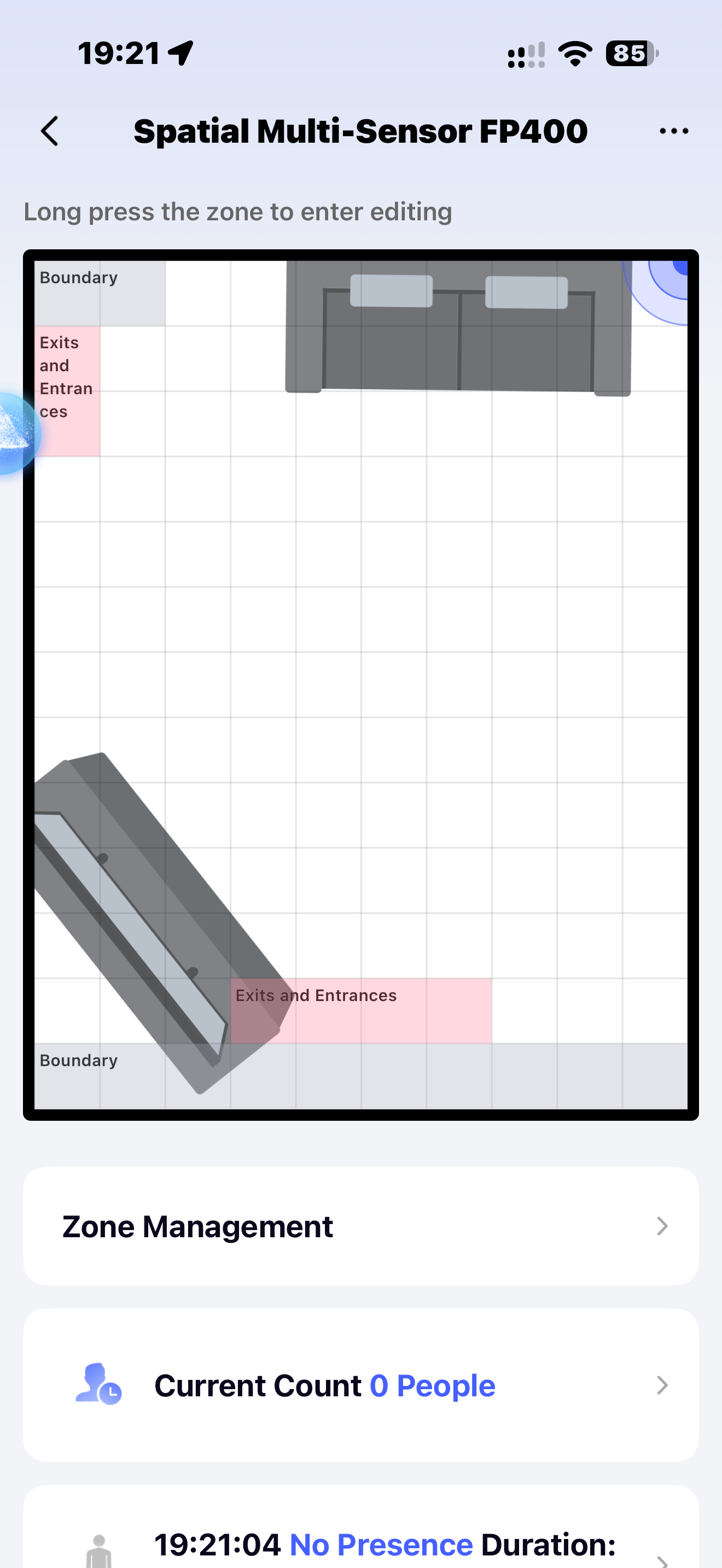
I moved the FP400 to the spot where my FP2 had been. The delay disappeared and hasn’t come back since.
So if yours is slow to react, have a look at what sits between it and the doorway. In my case, the room map made troubleshooting much easier: I could see that it had detected something well before it recognised me as a person.
It hasn’t forgotten me on the sofa
This matters more to me than the speed.
With the FP2, I’d occasionally sit still long enough for it to decide the room was empty. I haven’t had that happen with the FP400 during these two weeks, including some fairly long stretches on the sofa.
It’s only been two weeks, so I can’t say it’ll never happen. But so far, I haven’t had to wave an arm to get the light back.
The people counting has also been surprisingly accurate. I don’t use the count in any automations, but I’ve been checking it out of curiosity. Our cat even gets a little moving paw print on the map instead of a person icon. So far, it’s been reliably telling her apart from us.
How I’ve connected it
My setup is:
FP400 → Zigbee → Aqara Hub M3 → Matter bridge → Home Assistant
I chose Zigbee for the fuller feature set. My other Aqara devices are already connected to the M3, so it fitted into what I had.
I use the whole living room as one detection area, with both entrances marked. No extra zones. I know zones are a big part of what this sensor offers, but I only need to know whether someone is in the room.
Here’s the Home Assistant automation I’m using:
alias: Presence light living room
description: >-
  Turns the sofa light on when presence is detected and it is dark.
  Turns it off after the room has been empty for 2 minutes.
  Colour and brightness of the lamp stay untouched.
triggers:
  - entity_id: binary_sensor.living_room_fp400_occupancy
    to: "on"
    id: presence_on
    trigger: state
conditions:
  - condition: numeric_state
    entity_id: sensor.living_room_fp400_illuminance
    below: 60
actions:
  - action: light.turn_on
    target:
      entity_id: light.living_room_sofa_light
  - wait_for_trigger:
      - trigger: state
        entity_id: binary_sensor.living_room_fp400_occupancy
        to: "off"
        for: "00:02:00"
  - choose:
      - conditions:
          - condition: state
            entity_id: binary_sensor.living_room_fp400_occupancy
            state: "off"
        sequence:
          - action: light.turn_off
            target:
              entity_id: light.living_room_sofa_light
mode: restart
max_exceeded: silent
The built-in light sensor supplies the lux reading, and I’ve set the threshold to 60. The automation leaves the lamp’s colour and brightness alone and waits for two minutes of no presence before switching it off.
I’m happy with it so far. The quicker response is nice, but being able to sit still without the lights going out is the part I appreciate most.
My main advice after the first evening: check the placement and watch the room map as you walk in through each entrance. Moving mine a short distance made all the difference.
Thanks to the Aqara team for including me in the trial!