I’ve dropped my heating bill by 30-40% by installing IKEA Myggbett and Tado X smart radiators, I’ve added them in Aqara Home, and controlled by an M3 and G410 I’ve created a perfect automation. So, when the window is opened for more than 2 minutes the Radiator should switch off as long as the window is open, but if I close the window, I’ve put a waiting time for 2 minutes for the temperature to stabilize and if the outside temperature is less than 20C the heater will turn on at the last set temperature, but if the temperature is greater than 20C, the radiator will not turn on. Thats how I’ve dropped my heating bill and created the perfect Edge automation along side Aqara G410
11 Likes
Nice! I personally use Aqara E1 and W600 (and not Tado X) and I also saved a lot during winter. The most impactful on overall comfortable temperature and saving on heating was installing Aqara temperature sensors and W100 about 1-2m from the window, about 1.4m above the floor.
The sensors measure temperature farther from the window, which means it’s the temperature we feel in the room. So the heating didn’t kick in too early (when the window suddenly becomes cold) and there wasn’t many “fluctuations” (thermostat heating → temperature reached but rest of the room is still below this temp → temperature drop → heating kicks in again), the heating is more stable. Really recommend setup like this.
10 Likes
A drop in 30-40% is huge! Great achievement!
I’ve replaced my old Tado thermostats with Aqara W600 and automated with Aqara Door and Window sensors and temperature sensors. The automation I have is within Home Assistant and a Blueprint called Advanced Heating control. Works all perfectly fine as well
3 Likes
Hello, the savings are extremely large. But to achieve maximum results, a comprehensive approach is needed.
This is my screensaver that is responsible only for heating the house (electricity + gas).
2 Likes
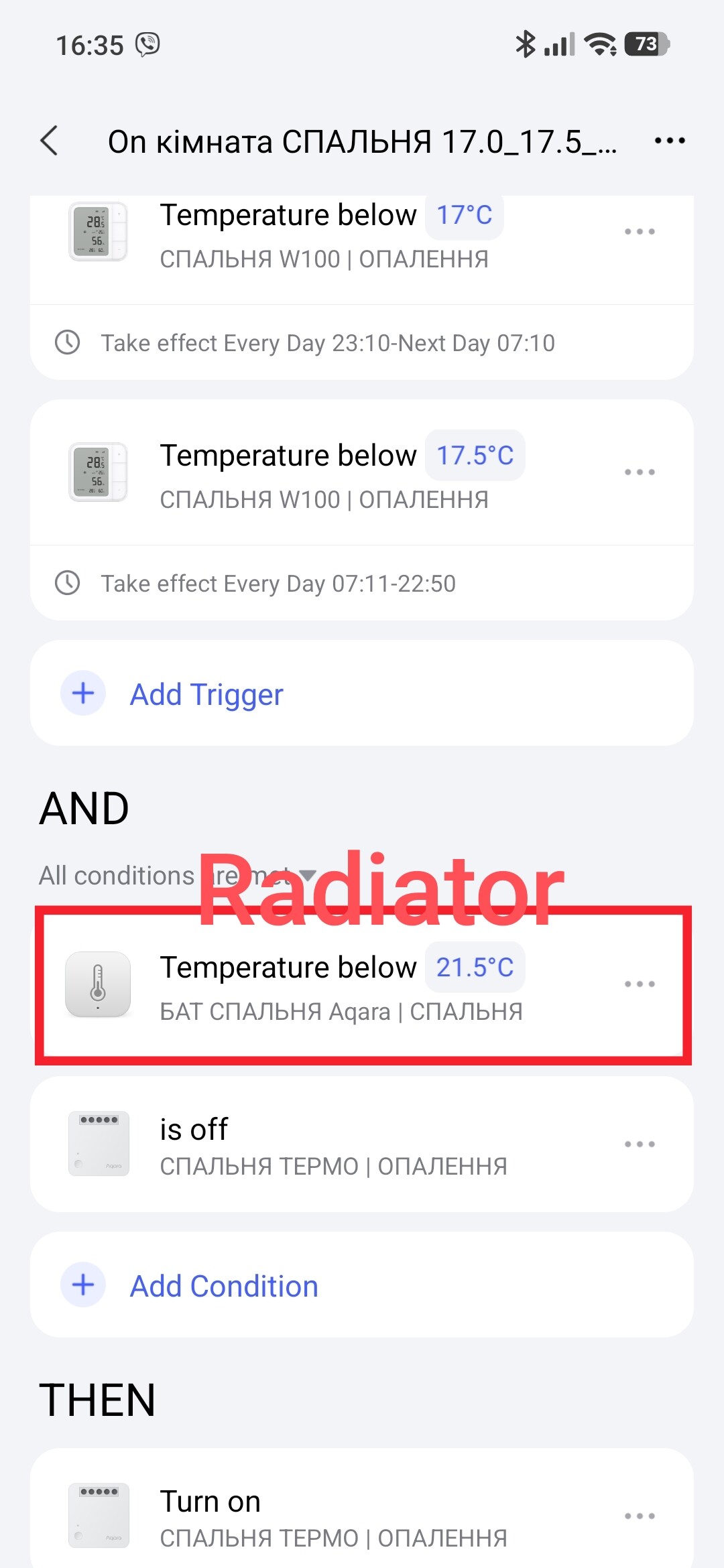
Just for information, the key role in my heating control system is played by a regular Aqara temperature sensor placed directly on the radiator (on the reverse side of the water flow).
This allows me to turn off the radiator in time and turn it on before the hysteresis of the battery temperature. In winter, I set it lower (Off~36C°-~On-24C°), autumn, spring (Off~36C°-~On-19C°).
The temperature was determined by an experimental method.
Now the room is completely free from overheating.
In my lessons, I never talked about this, I was afraid that users might get completely confused in the settings🤣
This is how the automation of turning on night, day and using radiator temperature looks like.
2 Likes
30-40% savings sounds more like a miracle than a thermostat upgrade. It is scientifically proven that every 1°C reduction in the setpoint typically reduces the heating bill by about 5-6%. To hit 40%, you would have had to lower your home temperature by nearly 7-8 degrees, which is a massive lifestyle change, not just a ‘smart’ optimization.
Also, comparing raw bill amounts is meaningless. Heating demand is a function of the temperature delta between inside and outside. Unless you are factoring in degree days (HDD) to normalize for the outdoor weather, your data is just noise. The post is a nice story, but unfortunately, those numbers are highly implausible in any realistic scenario.
3 Likes
The only way those numbers make sense is if your previous setup was so poorly managed that you were basically heating the entire neighborhood with your windows open. The post is a nice story, but unfortunately, those claims are highly implausible in any realistic, controlled scenario.
3 Likes
The “perfect automation” you described is actually just a manual workaround for Open Window Detection - a basic feature that has been standard in almost every smart TRV for over a decade. While using an external sensor like the IKEA Myggbett makes the trigger more reliable than simple temperature drop detection, it doesn’t magically change the laws of physics.
3 Likes
To clarify the “perfect automation” part: Typically, built-in algorithms detect a significant temperature drop (e.g., 3°C within 10–15 minutes) to trigger a shutdown, using hysteresis to decide when to resume. While using a physical sensor like the IKEA Myggbett definitely helps detect the open state faster and more reliably than waiting for a thermal drop, it certainly doesn’t account for a 30–40% reduction in your bill.
3 Likes