Hello!
I would like to use a sensor in the hallway and bathroom to automate movements. Basically to turn the lights on and off. Which products do you recommend for this task? Also, where should I place the sensors?
Thank you!
3 Likes
While a motion sensor would work in both applications you’d have to setup a timer to shut the lights off. In this case I would go with a presence sensor. The FP1e is excellent at detecting presence an I use one for my kitchen lights automations. In the case of having the best of both worlds the FP300 provides motion and presence. You could automate solely on presence or set lights on when motion is detected and off when there is no presence. The FP300 has the bonus of adding light, temp and humidity while using battery so placement can be made anywhere you’d need it.
In the case of a bathroom I’d place it on the inside corner by entrance pointed towards the toilet/sink/shower area to maximize detection of people. For the hallway it depends on how long it is but most likely the wall facing into the hallway would allow it to capture presence/motion. If using presence make sure to use AI Spatial learning when no one is in the room as it helps it learn the environment.
3 Likes
Hello. I have it organized like this. If there are any questions, I am ready to answer in the lesson topic.
4 Likes
Hello.
Where you install the sensors will depend on the size and layout of your hallway and bathroom. Motion detectors (P1/P2) and presence detectors (FP1E/FP300/FP2) are ideal, but window and door contacts are useful too. For example, the light switches on when you open the door, and if the system detects no person for a certain period of time, it switches the light off. However, if your rooms are very large and/or have many turns, you will need several sensors to detect presence.
In theory, in a bathroom with only one door, you could turn on the light as soon as the door opens and turn it off when it opens again. However, this would only work in a household with one person and no visitors 
Of course, you can also use cameras, such as the G5 Pro, to detect the presence of people and switch lights on and off. The advantage of cameras with facial recognition is that they can activate different lighting scenarios. Different colour tones or brightness levels, for example, can be selected depending on personal preferences. In addition, you can detect people lingering and then trigger other lighting scenes, for example, dimming the lights slightly. Although it is not ideal for the bathroom, it can provide additional security in the hallway next to the front door. This provides the insurance company and the police with immediate video evidence of a break-in or intrusion.
If you want to control multiple light sources in one room, the FP2 allows you to define different zones and control the lights in each zone separately. For example, in my home, the kitchen and hallway form one room. With the FP2 sensor, I can divide this room into two zones and switch on the hallway or kitchen lights separately.
4 Likes
For the hallway, I’d go with a motion sensor. Nobody hangs out there long enough to justify anything more advanced.
But for the bathroom, a presence sensor is your best friend. Once steam starts building up, regular motion sensors often turn into decorative wall art. In my case, it once left my wife standing in complete darkness in the shower. And yes, showering in the dark can be atmospheric… but in our house it usually ends with shouting and a very angry review of our so-called smart home.
Check this out: Topics to remember – Bookmark and keep coming back!
Always remember: “If your car is smarter than your home… you’re driving into the future while living in the past” 

6 Likes
Totally agree, I had an old Sonoff motion sensor in bathroom and if it got to steamy it would not function correctly and the person left in the dark looking like they are trying to direct a airplane into it’s taxi position  to activate it again. I’ve since started using an FP300 and that’s been flawless so far.
3 Likes
I just thought of something funny! You could use a humidity sensor to detect presence, since the values usually rise sharply when showering, after which the room is usually ventilated. So, you could create an automation that detects either movement or humidity above 70%. This could compensate for the failure of the motion detector.
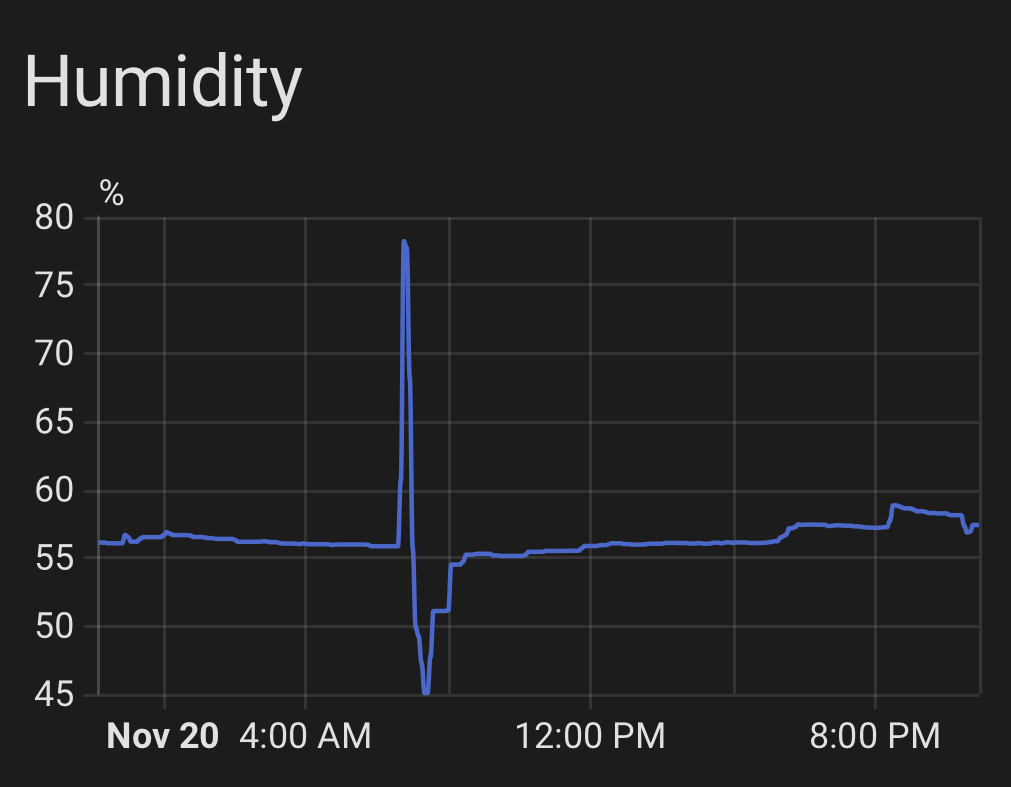
You can see quite clearly when I’ve had a shower.
2 Likes
Great, this is just right for me.
1 Like
This idea is suitable if there is no dryer in the bathroom, I researched it once. If you want things to “whiten” under the “sun” of the Aqara lamp light, then you can😀.
1 Like
You’re right, but I know how much power the tumble dryer uses, so that’s not a problem 
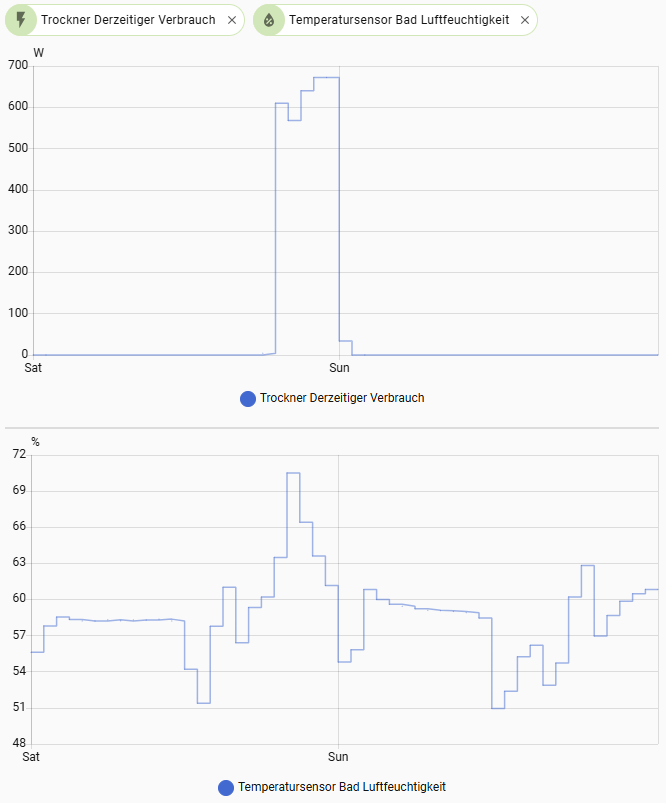
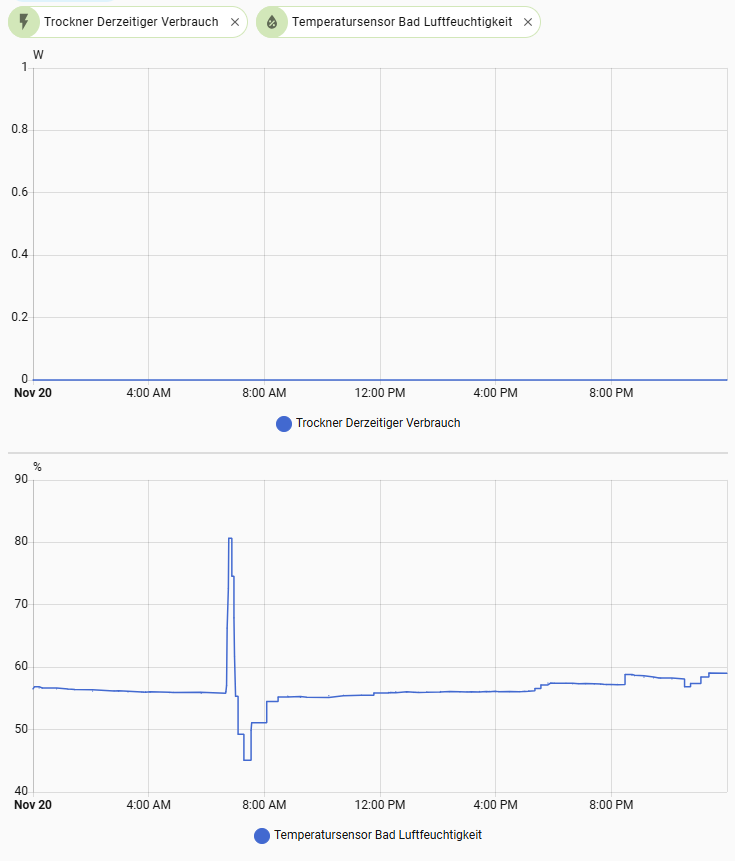
The values for the dryer can be seen in the first image, those for showering in the last image.
Also, the humidity rises faster when showering. So you could try the following:
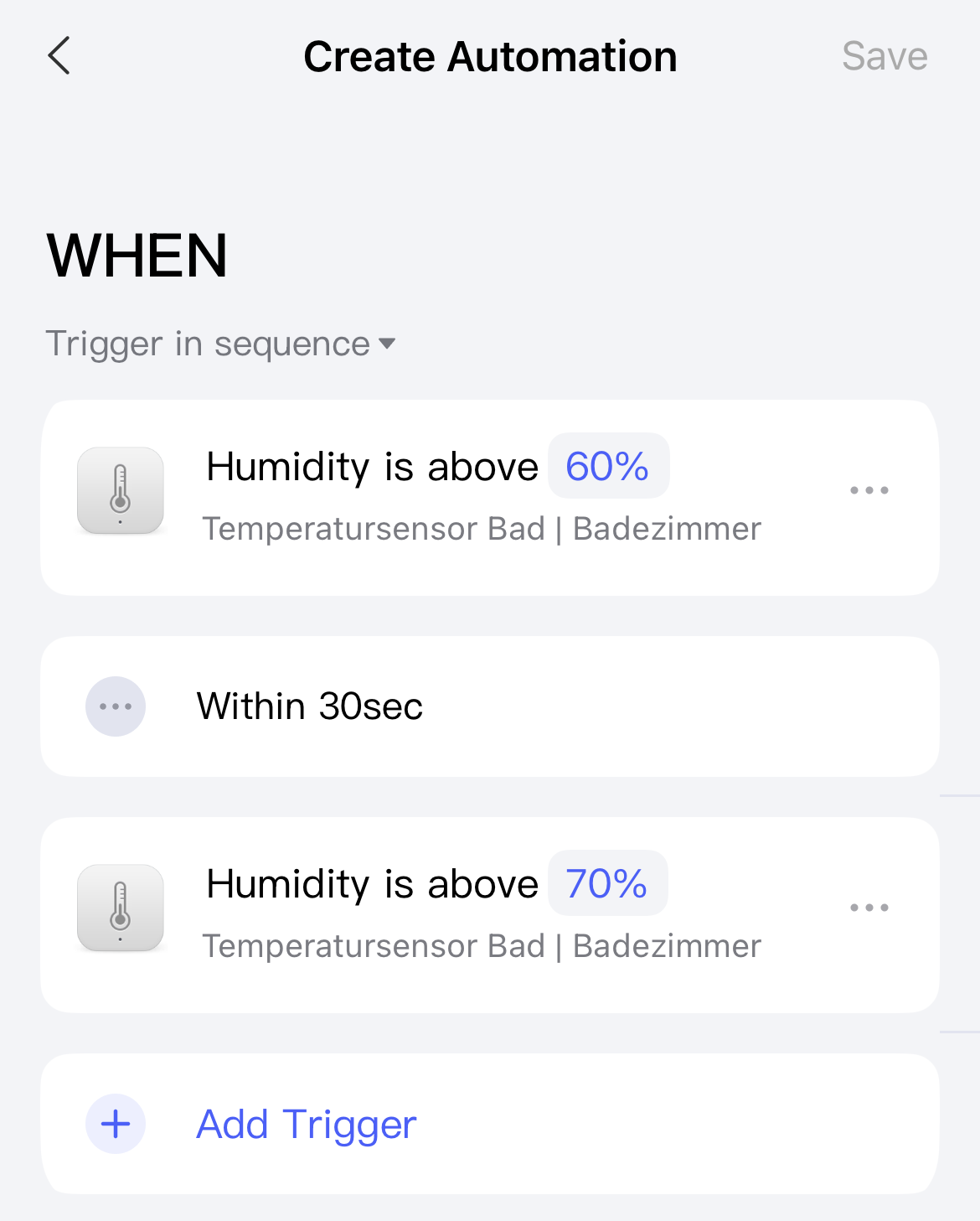
However, you would need to fine-tune it. Perhaps you should also use automation as a Boolean switch.
2 Likes