I have dual relay connected and set as dry contact. I also have connected w100 thermocontrolller but I cannot connect dual realy as a thermocontroller of w100, so w100 directly turn on/off my heater. The connect thermocontroller dialog only see hub m3 but not the dual realy. The workaround is to use automations but it is not so comfortable. I want to use w100 to set a new desired room temperature via buttons. Firmware is updated on all devices.
2 Likes
You have connected the W100 to a thermostat (E1 ?) , but you also have a Dual Relay T2 that you want to use to switch your entire heating system on and off? Have I understood you correctly?
2 Likes
The W100 is not a thermostat, it’s simply a remote display 'climate sensor’s for another device.
I have complained about this here: Aqara W100 Thermostat
If you want to use it to control a central heating boiler you need to do so via an automation based on the associated E1 TRVs: Gas central automation - #3 by avram_bv
Or as I discovered, you can use the Tado thermostat via matter: Aqara W100 Thermostat - #23 by nzjrs
Aqara has so far not understood that people see the W100 as a possible wireless thermostat. I hope @XT-XianTang from aqara will see your thread, I think he works on the thermostats. Ive tried to explain to him my request in a few threads without success. The W100 software hasn’t been updated since launch.
3 Likes
It only works with the E1 thermostat. That’s how it will be advertised. There is no other information.
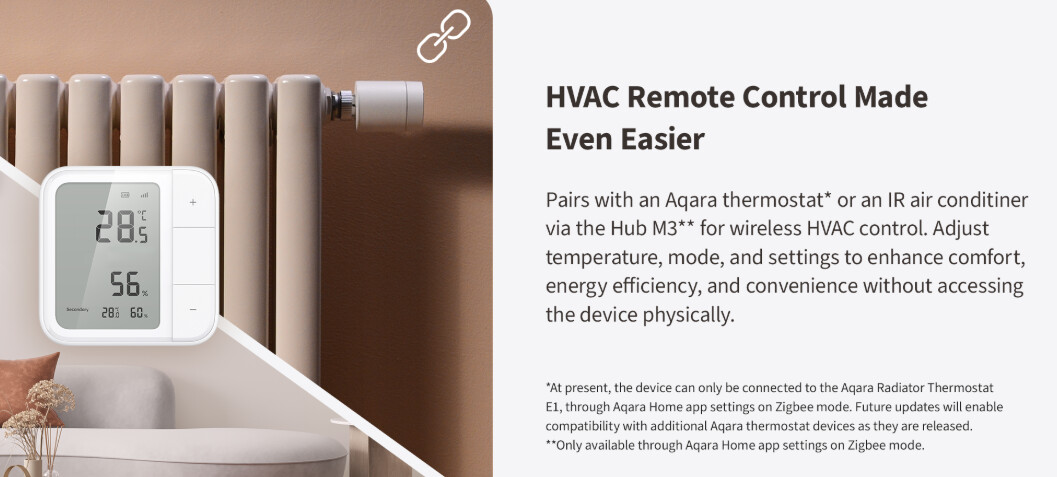
You want T2 to be supported too, since it can be used for heating systems? I imagine that would be difficult to implement.
2 Likes
Hello, welcome to the forum.
Yes, unfortunately W100 does not allow you to use it as a thermostat in conjunction with the T2 relay. This function is supported only in W500, W600 and TVR E1. At the moment I have started a course of lessons dedicated to the heating system. The first lesson is creating a smart schedule based on automation. The following lessons will be dedicated to your question. Automation 2.0, lesson 10, room climate control. Creating a smart heating schedule for radiator thermostats (E1, W500, W600)
2 Likes
Another question is, does the W100 control the entire apartment or does it send a signal to some device (relay, W500, W600, E1).
Is there 1 or more W100 in your house?
3 Likes
That’s factually not true (I’ve complained about the German Amazon page calling this a thermostat).
(if Aqara and friends want to keep blaming the customers for seeing a device with a settable temperature and thinking it’s a thermostat, advertising it occasionally as a thermostat, I would say even implying it is a thermostat openly ‘in conjunction with Xxx’, then they will continue to have threads like this posted on the forum and similar questions in Reddit and Facebook)
1 Like
Amazon really is something special. I’ve been working in e-commerce for 20 years, developing software that connects retailers to Amazon via an API. I can tell you that the information in Amazon’s product descriptions may not be accurate, nor necessarily come from the official retailer. Essentially, anyone with a business licence and a delivery note for the product can edit or add an image or part of the description. Normally, an algorithm at Amazon decides which retailer is allowed to specify or change which parts of the product information. Typically, the brand owner or the original data creator has priority, but this is not always the case. In the case of the W100, another retailer has clearly created a duplicate product and labelled it an ‘air conditioning sensor’. The other product is titled ‘thermostat’, but only Amazon can clarify who is responsible for the names. As a customer, you can report any incorrect information to Amazon. Unfortunately, I can’t tell you whether or how these will be removed. In most cases, nothing happens, as I have found out through my own experience. Conversely, retailers can only submit product data (such as the name) as a suggestion. There is no guarantee that Amazon will include the data in its product catalogue. The retailer can open a case in Seller Central and report incorrect information. From experience, I can say that this process can take a very long time, or nothing may happen at all. A decision is then usually made by Amazon employees who are unfamiliar with the product, which can result in the wrong decision being made and the incorrect information remaining. Amazon also asks retailers if they would like to offer their products on other marketplaces in different countries. One click of “Yes” and the products are automatically translated. Clearly, this does not always work well.
1 Like
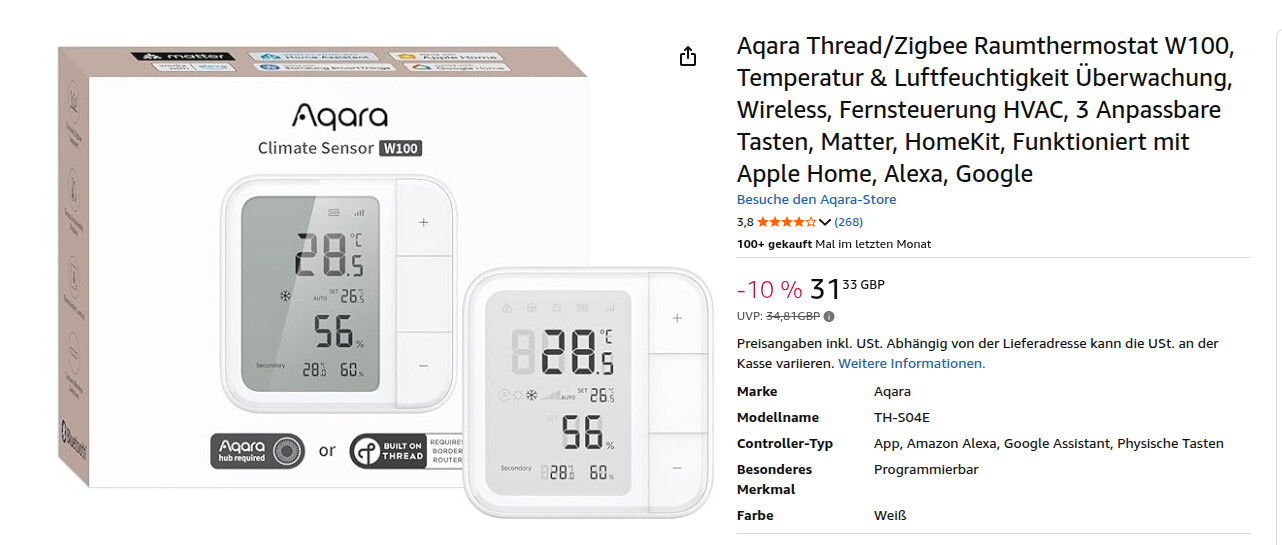
Wie bereits erklärt, kann, aber muss nicht, Aqara daran schuld sein, es kann auch ein anderer Händler bei Amazon falsche Daten hinterlegt haben und dann kann Aqara das vermutlich nicht ändern.
Klicke auf „Ein Problem mit diesem Produkt melden“ und dann das Formular ausfüllen:
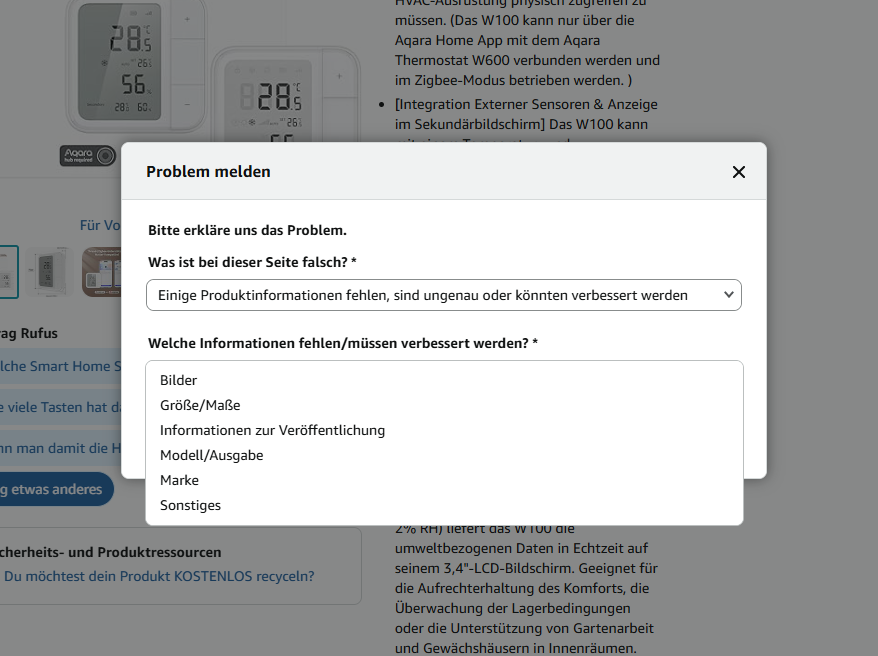
Das habe ich vor Monaten auch schon gemacht. Aber wie bereits geschrieben, kann ich aus Erfahrung mit Amazon sagen, dass sie sehr träge sind, was solche Dinge angeht.
Na geh, es ist nicht meine Problem. Ich habe genug gratis Arbeit fur Aqara schon gemacht (hier auf forum usw).
Urspunglich ist die problem Aqara hast so ein Pfusch product gemacht.
Wie schon gesagt, kann es auch ein anderer Händler gewesen sein. Bei Amazon kann jeder, der sich dort anmeldet, alles verkaufen. Er kann auch Unsinn in die Beschreibung schreiben. Das bekommt man nur weg, wenn sich viele Leute darüber beschweren. Und genau diese Gleichgültigkeit führt dazu, dass es so bleibt, wie es ist.
Aqara: Lass uns ein Produkt entwickeln das 90 % ein Thermostat ist, aber eigentlich ist nur eine verwirrende Fernbedienung.
Normale Leute: Klingt wahnsinn
Aqara: Hahaha nicht unser problem. Wir vertrauen alle verkaufer ehrlich zu sein.
Ich verstehe ja deinen Frust, aber du unterstellst hier Absicht, was so vielleicht gar nicht stimmt – aus meiner Erfahrung in 20 Jahren E-Commerce mit Amazon sogar sehr wahrscheinlich nicht stimmt – und das ist nicht fair.