My review as a beta tester
I’ve been testing the Aqara FP400 for a while now and wanted to share my experience, particularly compared with the FP300.
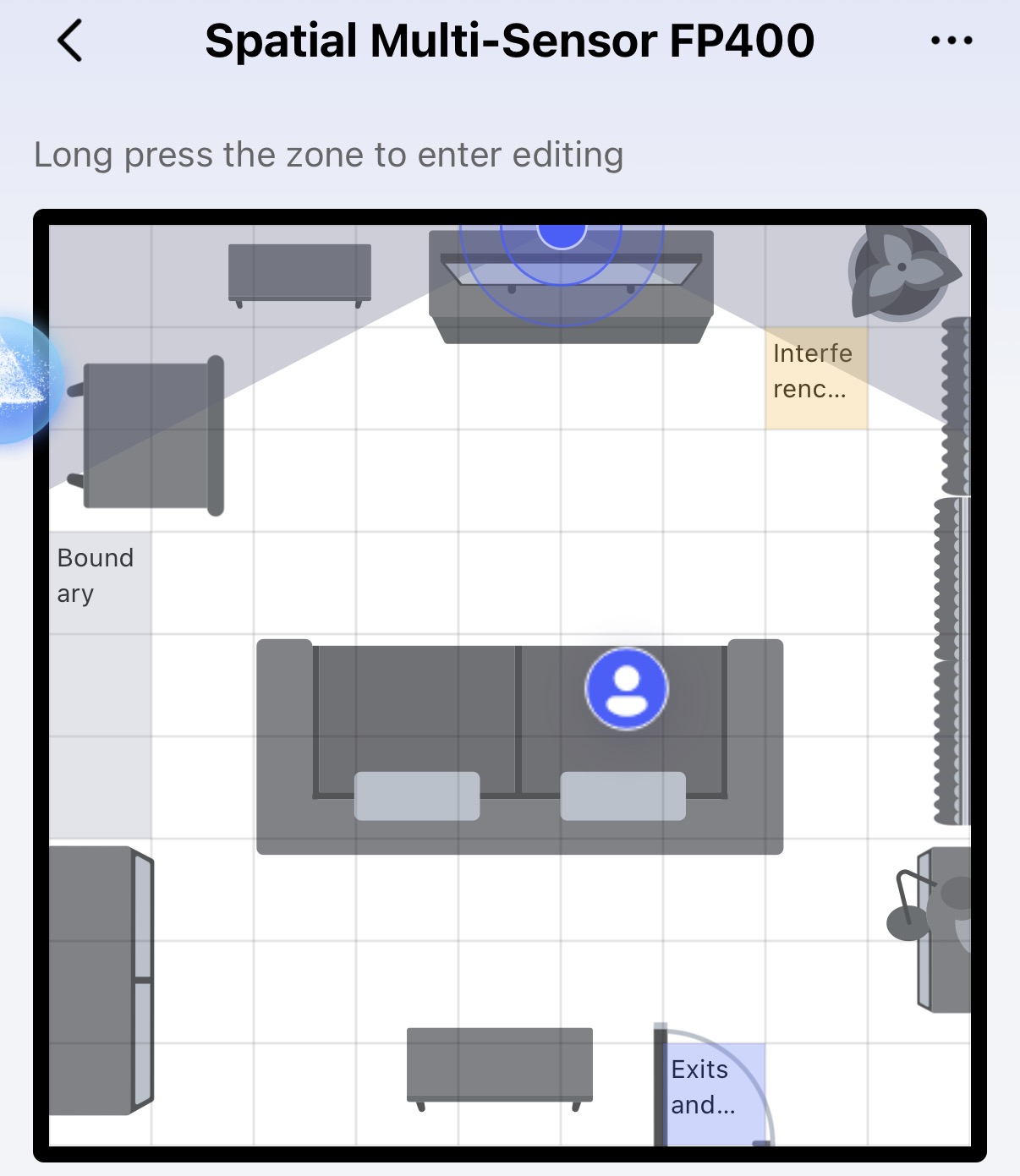
My main reason for trying the FP400 was to improve presence detection in my living room, especially when people are sitting fairly still on the sofa. My living room has a fairly typical layout, with the sofa on one side of the room and the TV/chimney breast opposite. Two people can be sitting at opposite ends of the sofa, so reliable coverage across the whole seating area is important.
Unfortunately, my biggest issue with the FP400 has been inconsistent stationary presence detection.
At times it works extremely well. After experimenting with the positioning, I managed to get stretches of 20–30 minutes, and on one occasion around an hour, without it losing me while sitting on the sofa. However, I would then suddenly disappear from the Aqara app for several seconds despite not having moved from the seating area.
Interestingly, positioning made a huge difference.
I initially had the FP400 angled down towards the sofa, which seemed the logical way to install it. However, I found that pointing it more or less straight ahead actually appeared to improve stationary detection considerably. I also experimented with lowering the sensor from its original position and moving it around the room.
I tried:
• Different mounting heights
• Angling the sensor down towards the seating area
• Pointing it straight ahead
• Changing proximity settings
• Re-running AI spatial learning
• Turning AI features off to compare behaviour
• Different absence timers, including 20 and 30 seconds
• Repeated testing while sitting still in different parts of the sofa
Re-running the spatial learning and changing the angle sometimes improved things, but I was never able to get completely reliable detection across the entire sofa.
The most frustrating part is that the FP400 is clearly capable of detecting someone sitting still. When it works, it works extremely well. The problem seems to be consistency rather than sensitivity in general.
Increasing the absence timer can hide very short dropouts, but I don’t think that really solves the underlying issue. A long absence timer also makes lighting automations noticeably slower when somebody genuinely leaves the room.
This matters particularly with HomeKit/Matter automations. If the sensor briefly decides the room is empty, an automation can start its absence countdown even though somebody is still sitting there. For presence-based lighting, reliability is ultimately more important than having lots of additional features.
Another consideration in my house is pets. We have two cats and a dog, so separating genuine human presence from pets is important. This is one area where the more advanced intelligence of the FP400 could potentially be extremely useful.
For comparison, I eventually went back to my ceiling-mounted FP300. It may be the simpler sensor, but in my room it currently gives me more predictable presence detection for the sofa, which is ultimately what I need from it.
I don’t think the FP400 is a bad sensor at all. In fact, my testing suggests the hardware has a lot of potential. When I found the right positioning it could track me sitting almost completely still for long periods, which is impressive.
However, at the moment it feels as though the tracking algorithms still need some refinement, particularly around:
• Maintaining stationary presence at the edges of the detection area
• Avoiding brief unexplained presence dropouts
• Handling people sitting or reclining on sofas
• Making mounting angle less critical
• Improving consistency after AI spatial learning
It would also be useful if Aqara provided more detailed guidance about optimal positioning. My experience of the FP400 actually working better when pointed straight ahead rather than down towards the sofa was not what I expected, and I suspect other users could spend a lot of time experimenting with placement.
Overall, I think the FP400 has the potential to be an excellent presence sensor, but at the moment my FP300 remains more reliable for my particular living-room setup.
I’ll continue following updates because this feels more like something that could potentially be improved through firmware and algorithm changes rather than a fundamental limitation of the hardware.
I have also attached a picture of my room layout for reference.
 Earlier this year, many of you joined our FP400 Exclusive Trial and got hands-on with the device before everyone else. Now we’d love to hear what you think.
 50 points for every valid submission
 Outstanding posts earn an extra 200 points